
Rumpelstiltskin AI Scenes: Hay Barn, Torch-lit Hall or Moonlit Courtyard?
Choose the right Rumpelstiltskin AI scene for your joke, lighting and movement. Compare three creative settings and understand the fixed hay-barn workflow in our two-mode studio.
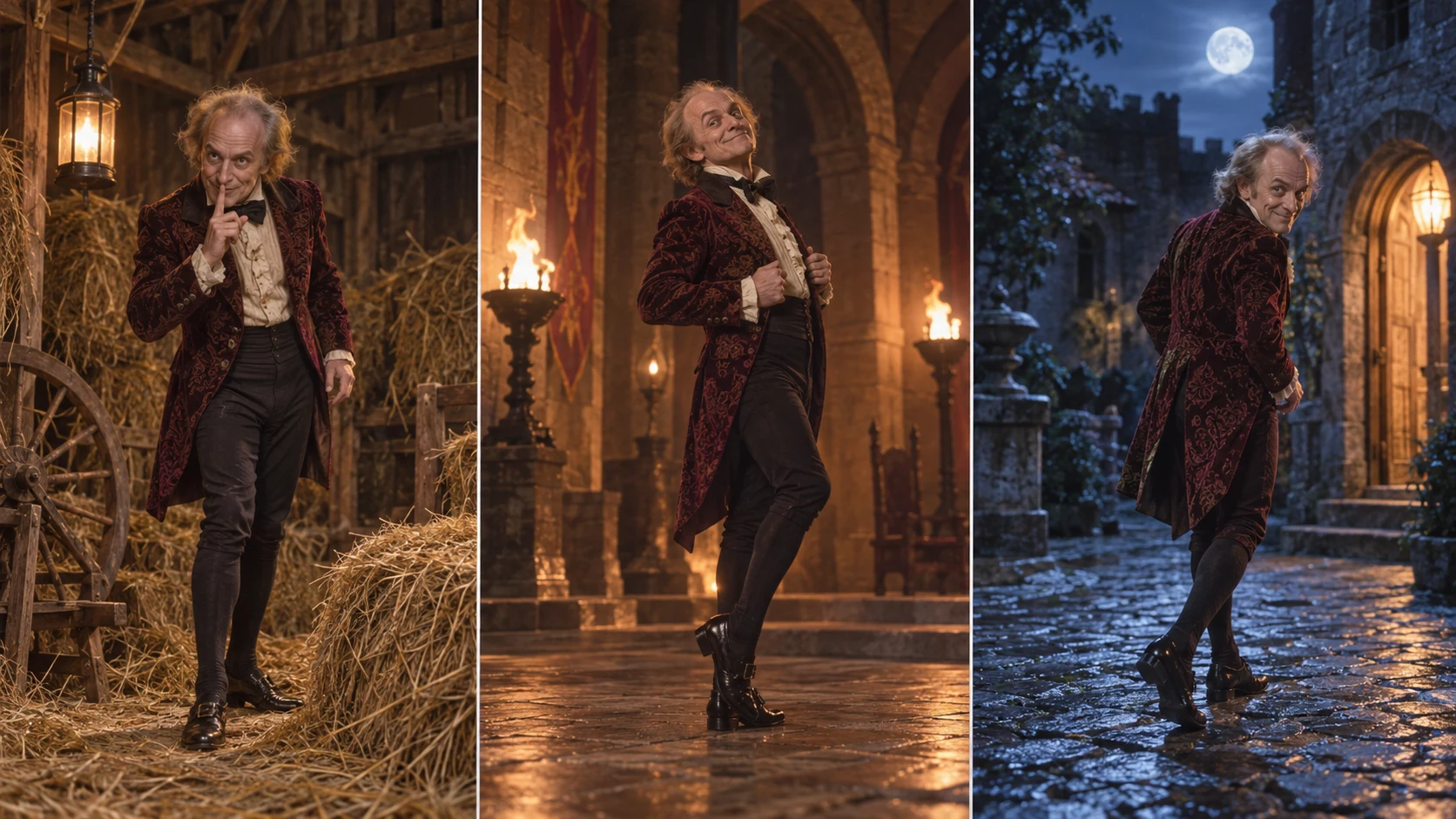
Pick the setting that makes the joke stronger
A character doing the same tiny victory dance can feel completely different in a barn, a royal hall or an empty courtyard. The barn makes the achievement feel wonderfully ordinary. The hall gives it absurd importance. The courtyard turns it into something secret. Choose that meaning before choosing the lighting.
Rumpelstiltskin AI now concentrates on the hay-barn dance, with You dance for one identity photo and You and a friend for separate dancer and watcher photos. Its fixed scene preparation supplies the setting and costume. The hall and courtyard below are editorial ideas for a separate, editable creative workflow; they are not settings in our current toolbar.
The scene decision matrix
For an original project in a tool with scene controls, start with the response you want from the viewer. Choose the setting whose light, objects and space support it. In our fixed workflow, use the barn row to plan your casting and final caption.
| Your intended moment | Choose | Light and mood | Direct this action |
|---|---|---|---|
| A familiar, mischievous fairy-tale joke | Hay Barn | A warm lantern against straw and timber; intimate and earthy | A conspiratorial shush followed by compact steps |
| An ordinary task treated as a royal achievement | Torch-lit Hall | Warm torchlight on stone; ceremonial and theatrical | A proud pause or deliberate entrance |
| A secret departure or a suspiciously innocent reaction | Moonlit Courtyard | Cool moonlight with a warm doorway; quiet and mysterious | A sideways departure and a look back |
If two scenes fit, finish this sentence: “The character thinks this moment is…” Choose secret, magnificent or a clever little victory. That one answer usually settles the scene more decisively than collecting visual references indefinitely.
Hay Barn: make the character the attraction
Choose the barn when the expression and footwork should carry the entire idea. Straw, timber and a warm lantern establish a recognizable fairy-tale world without requiring an elaborate introduction. It is a terrific foundation for domestic jokes, small triumphs and exaggerated confidence.
Keep the arrangement simple. A hay bale can sit behind the character; the floor in the movement direction should remain open. Describe the lantern as the principal light so the brief has a clear visual hierarchy. Asking for candles, moonbeams, glowing coins and moving sparks at once gives each element less purpose.
The useful question is: would this still be funny with the background blurred? If yes, the barn is doing its job. Let the character grin, gesture or step. Save a complicated transformation for a different concept rather than forcing it into the same short sequence.
For a caption about turning leftovers into a feast, a modest barn makes the boast land. The corresponding lines in our original meme-caption collection can help you connect the everyday situation to the visual joke.
Torch-lit Hall: give a small action enormous importance
Choose the hall when the joke depends on ceremony. A person who has answered one email can stand as though awaiting a royal appointment. Stone architecture supplies the importance; an understated gesture supplies the comedy.
Keep the subject close enough for the face and hands to matter. A vast establishing view may communicate an impressive building while losing the raised eyebrow that makes the scene funny. Use one or two visible architectural features to suggest grandeur, rather than making the character disappear inside it.
Pick a single performance priority: an entrance, an offer or a proud final pose. If the character is already centered in the opening image, a controlled pause may fit better than demanding a long walk across the hall. In an external tool with an editable brief, change the action to suit the actual starting composition. Our studio keeps its barn direction fixed.
Moonlit Courtyard: create a reason to look back
Choose the courtyard when the action involves leaving, listening or keeping a secret. This editorial concept pairs moonlit stone with a warm lantern by a doorway. That contrast gives the composition an immediate destination: a character can move toward the warmth while glancing back into the cooler space.
Make the geography readable. Place the doorway on the side toward which the movement is directed, and leave paving between it and the character. If your image puts the doorway behind the figure, adjust the direction rather than asking for an unrelated sideways exit.
Darkness should create mood without erasing the expression. Describe gentle light on the face and a visible outline around the coat. A completely black silhouette suits a mystery reveal, but it weakens a joke that depends on a knowingly innocent smile.
Turn the setting into a coherent plan
For an open-prompt project elsewhere, choose the setting before writing movement or camera instructions. Keep a copy of the brief and change one decision at a time. A new doorway, different camera position and faster dance all at once make the next result harder to assess.
Our fixed studio requests 10 seconds at 768P with a portrait 9:16 direction. Use the actual scene and motion in the result to choose your opening, caption and ending. Our seven prompt ideas remain complete briefs for external tools with prompt input; they do not change the instructions inside our toolbar.
In our studio, the uploaded portraits identify the cast. Scene preparation is intended to establish the barn and wardrobe before animation, rather than preserve every background detail in the source photos. Use our photo-versus-text decision guide to distinguish that identity-photo workflow from direct first-frame animation or text-led creation elsewhere.
Choose flexibility when the setting is part of your idea
A fixed backdrop is a strong fit when recognition matters: straw, formal costume and a reaction make the intended joke clear. That is the focused choice our studio makes. If a royal hall or moonlit escape is essential to your idea, use a separate tool that exposes those scene controls. Choose by the creative job instead of assuming every generator offers the same freedom.
For the barn dance, choose a compelling dancer and decide whether a specific friend should react. Bring those identity photos to the studio, then use our framing guide when reviewing and editing the result. Give the cast a clear relationship and the finished post a sharp purpose.